Before the First Line of Code: Why Infrastructure Modernization Dies in the Planning Room
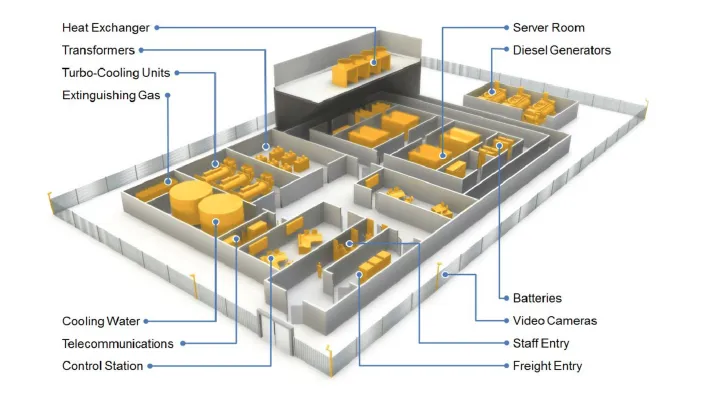
Photo: enterprise server room infrastructure planning blueprint, via i.pinimg.com
Every year, enterprises across the United States commit substantial capital to infrastructure modernization initiatives with the expectation of reduced operational costs, improved agility, and a competitive edge in increasingly demanding digital markets. And every year, a significant portion of those initiatives stall, balloon beyond budget, or quietly fail — not because the technology was wrong, but because the groundwork was never properly laid.
The uncomfortable reality is that most modernization projects are compromised before a single server is decommissioned or a single workload is migrated. The failure modes are remarkably consistent across industries, organization sizes, and technology stacks. Recognizing them is not merely an academic exercise — it is a prerequisite for any enterprise serious about executing a successful infrastructure transition.
The Discovery Gap: What You Don't Know Will Cost You
The most common and most damaging error in enterprise modernization planning is an inadequate discovery phase. Organizations frequently underinvest in understanding the full scope of their existing environment, relying instead on documentation that is years out of date, tribal knowledge held by a handful of engineers who may no longer be with the company, and high-level architectural diagrams that bear little resemblance to operational reality.
Legacy systems, particularly those built or significantly modified over a decade or more, accumulate dependencies in ways that are rarely documented. An application that appears self-contained may have undocumented integrations with three internal APIs, two external data feeds, and a batch process running on a server that no one officially maintains. These invisible connections only surface when a migration is already underway — at which point the cost of addressing them is exponentially higher than it would have been during planning.
A rigorous discovery phase should involve automated dependency mapping tools, structured interviews with operational staff at every tier, and a deliberate audit of network traffic patterns over an extended period. Anything less leaves the planning team operating on incomplete information, and incomplete information produces inaccurate estimates.
The 'Newer Is Better' Fallacy
There is a persistent and expensive assumption embedded in many modernization programs: that adopting newer technology is inherently beneficial, and that the primary challenge is simply executing the transition. This belief systematically underestimates the operational complexity that modern infrastructure platforms introduce.
Cloud-native architectures, containerized workloads, and distributed systems offer genuine advantages — but those advantages come with a corresponding increase in operational sophistication requirements. An organization that has spent fifteen years managing on-premises infrastructure with a stable team of generalist engineers does not automatically acquire the expertise needed to operate a Kubernetes-based platform across multiple cloud regions. The technology changes; the institutional knowledge required to run it safely and efficiently does not transfer automatically.
This skills gap is rarely accounted for in modernization budgets or timelines. Training programs are underestimated in duration and cost. The assumption that existing staff will adapt quickly is frequently optimistic. And the alternative — hiring engineers with deep cloud-native expertise in a competitive US labor market — carries a price tag that can fundamentally alter the economics of a modernization business case.
Scope Creep Disguised as Ambition
Modernization projects frequently suffer from a structural tension between the desire to solve every known problem simultaneously and the operational reality of managing a live production environment during a transition. The impulse to consolidate, re-architect, and optimize in a single initiative is understandable — but it is also a reliable path to project failure.
When the scope of a modernization effort expands to include network re-segmentation, identity and access management overhaul, observability platform replacement, and application refactoring alongside the core infrastructure migration, the project's complexity grows non-linearly. Each additional workstream introduces its own dependencies, its own risk surface, and its own demand on engineering bandwidth. The result is a program that attempts to do everything and delivers significantly less than a more focused effort would have achieved.
Successful modernization programs are deliberately bounded. They define clear, measurable outcomes for each phase, resist the temptation to solve adjacent problems mid-execution, and maintain a strict separation between what is being changed and what is being preserved for a subsequent initiative.
The Vendor Assumption Problem
A frequently overlooked failure pattern involves the gap between vendor-provided migration guidance and the operational reality of a specific enterprise environment. Technology vendors have a commercial interest in making migrations appear straightforward. Their reference architectures, migration tools, and professional services engagements are designed around representative use cases — not the particular combination of legacy systems, custom integrations, and regulatory constraints that characterize most mature enterprise environments.
Enterprises that rely too heavily on vendor-led migration playbooks without conducting independent technical validation routinely discover that the guidance does not account for their specific constraints. Security requirements, data residency obligations, compliance mandates, and performance SLAs may each introduce complications that the vendor's standard approach does not address. By the time these gaps become apparent, the organization is often already committed to a timeline and a budget that cannot absorb the necessary adjustments.
A Framework for Modernization That Survives Contact With Reality
Addressing these failure patterns requires a disciplined approach that prioritizes accuracy over optimism at every stage of planning.
Invest disproportionately in discovery. The cost of a thorough pre-modernization assessment is a fraction of the cost of encountering undocumented dependencies mid-migration. Automated discovery tooling should be supplemented with manual review and operational staff interviews. The goal is a dependency map that reflects reality, not documentation.
Conduct an honest skills inventory. Before committing to a target architecture, assess whether the organization has the operational expertise to run it sustainably. If the answer is no, factor the cost of acquiring that expertise — through hiring, training, or managed services — into the business case from the outset.
Phase aggressively. A modernization initiative that delivers incremental, verifiable value at each phase is more likely to succeed than one that defers all benefits to a single large cutover. Phased delivery also provides natural checkpoints for reassessing assumptions and adjusting course before problems compound.
Validate vendor guidance independently. Treat vendor migration playbooks as a starting point, not a blueprint. Engage independent technical expertise to evaluate whether the proposed approach is appropriate for the specific environment, and identify gaps before they become mid-project crises.
The enterprises that execute successful modernization programs are not necessarily those with the largest budgets or the most sophisticated technology choices. They are the ones that invest the time and discipline to understand what they are working with before they begin changing it.